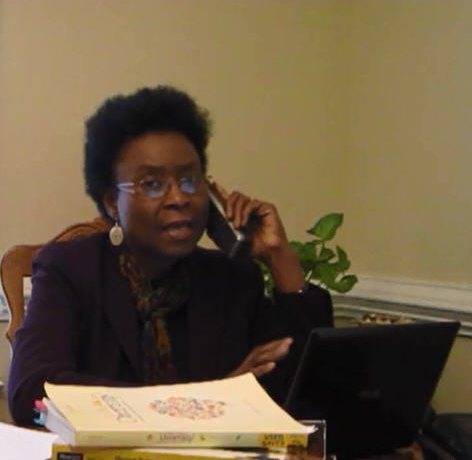
An Introspective Look into the Person that is Celersteen “Pepper” Brown
Starting this paper was no easy task. For me, it is always difficult to know where or how to begin talking about myself. In order to complete this assignment, I was required to look at my past or where I come from, my present or where I am today and my future or what are my life prospects. I will begin this project by talking a little about my background, who I am; Why I’m here; Where I come from; and what I want out of life? I will also discuss my belief system and values, my thoughts on my own self-awareness as well as my coping skills, and learning styles.
Some would not think so, but growing up in a large, rather strict family in rural South Carolina, set the tone for the life of Celersteen “Pepper” Brown. Since I was such a shy child, all of my family and friend were caught off guard and were completely shocked when they learned that I had left home to join the Air Force. They were even more surprised when I did not return and resume my life where I left off in 1977. Because I did not stay in my home town, and never went back for more than short visits, the entire course of my life was completely changed. I became a totally different person than the one I would have been had I stayed in Scranton, South Carolina.
Who Am I? -When looking at the question, “Who am I?” I had to pause for a while and really think about the question. Can I separate who I am from what I do? The answer for me is NO . . .
My name is Celersteen Brown but most people call me Pepper. I am a first year Masters of Social work student at Fayetteville State University, North Carolina. I also retired from the Air Force as an E-9 (Chief Master Sergeant) after 31 years active duty and reserve service. I am married to my husband William Sanders who is also an Air Force retiree. I live in a small town of around 2,000 called Four Oaks, North Carolina, where I am an avid gardener.
I am an accumulation of many things that I have experienced in my life. Just a few of these things are stated above and greatly contribute to me being the person I am today. Furthermore, I am the product of my parents, J.C. and Margarette, who instilled certain positive spoken and unspoken values and beliefs in me at an early age. In doing so, they sat the foundation for the individual that I would become. What I think, do, and feel along with all of my past experiences, makes me who I am today.
My Values and Belief System – Our belief system is a way we perceive and relate in a society directed by a set of traditional morals. It is also the individual’s conception of what is right or wrong. This is a crucial part of who we are and how we behave. Our personal belief system is made up of all the previous traditions, knowledge, and experience that govern our thoughts, words and actions (Kapeleris, 2014). Values are about how we have learned to think or feel thing should be or the way people should to behave, especially in terms of qualities such as honesty, integrity and openness.
My parents instilled in me at an early age that I was expected to do the right thing even if no one is looking. They said things like, “what you do in the dark shows in the light.” They also taught us about the golden rule, even though they didn’t call it that. They just said, “Treat people the way you want to be treated.” Additionally, they used to say, “If you have to think about whether it’s right or wrong, it’s probably wrong.” The other thing that they insisted on was giving back, and taking care of family. This was not just blood relatives, but the neighbors and friends that helped to raise us. They had a lot of sayings like these that I have carried with me throughout my life.
My mother was a minister and she always told us that no matter what else we did we need to thank God every day. We were told to live our lives according to God’s word and we would be in his favor. That goes back to the golden rule, and giving to those in need, and helping to take care of those that are not able to take care of themselves. Moreover, we were always taught that God had the first and last word in all things and that we could not overrule his judgment. When I grew up, I took that to mean that we are set on a certain path from birth and no matter what we may do, think, or believe we will end up where God intended us to be.
Why Am I here? – Everyone has a purpose or a reason for being in a particular place at a designated time. Many times we have a plans that do not go the way we think they should. For instance, my plan was to start graduate school in August, 2013. But that is not what happened. Some things did not go according to my agenda. Apparently God had other plans. As a result, I was thrown a year behind because something that should have made it into my package didn’t. At first I was angry, hurt, and disillusioned because my strategy was not working out as I had intended. Eventually, I had to accept the fact that there was a timetable that was not my own. Had I started according to my schedule, I would not have some of the greatest people I could hope for in my life.
Salient Aspects of Human Development Important in My Shaping Life. – I grew up in a somewhat large family and my position in that family was determined by the fact that I was the oldest female. My family was very strict and because I was female I was never encouraged to excel at anything except church, school, and home. Nothing else was allowed. I was constantly told what I could not do because I was a girl. I was not allowed to play sports or join the band and the only reason given was, “You’re a girl.” As a result, I decide that I was not going to stay in this small stifling situation for the rest of my life. I thought that after college I would move to a larger city like Charleston or Columbia but did not really think about moving outside of South Carolina. I didn’t think of it until June 7, 1977.
I was on my way home from school when I began having a conversation with myself. The jest of the conversation was about who I was and why I was still living in the same basic situation I had lived all of my life. I was still living in the same town, in the same house, with the same people doing the same things I had always done only I was no longer a child. I felt as if I were dying inside with nothing to look forward to except doing the same thing again the next day, the next week and the next year. That day I did what I had been thinking of for several years. Instead of going home after school, I went to the Air Force Recruiter’s office and I enlisted. This was the greatest decision of my life.
Where Did I Come From? – As earlier stated, I grew up in a small country town in South Carolina. I come from what most people would call a somewhat large family. There were seven children and my mother and father. I was the third child and the oldest girl in the family. As a result of my position in the family, it was my job to help raise the four younger children and “keep the house”. These are two of the things I least enjoyed in my young life. I was thoroughly groomed to become a wife and mother, just as my mother had been, and my grandmother, and my great grandmother and soon. The thing is that this training did not stick, at least not the way my parents thought it would or should. I knew I did not want to spend my entire life anywhere near my hometown and I definitely did not want the same type of life as my foremothers. I knew that I wanted something different for my life.
What do I Want in life? – There are several things that I would like out of life. First, would really like to travel more and experience all of the places in the United States that I read about in books but have not yet seen. It would also give me great pleasure to be able to volunteer more and help others without feeling that something else will suffer. Furthermore, I would like to be a better person and know that at the end of the day I have done all that I can do and be content with the way things are. Additionally, I would like to be more personally organized and not feel as if I am always behind like this semester. This may sound like an unimportant detail to some, but to me it may as well be the pyramids of Giza. I find this to be tremendously frustrating as I feel that I will never catch up. The bottom line is that I want to be in a place of homeostasis. Finally, at the end of the day I hope the response to all deeds will be, “Well done”.
Goals – I think quite often about what I want out of life and where I see myself in the future. My immediate goal is to become more organized. I have to find a way to regain equilibrium when the unexpected occurs and not fall further and further behind as I did this semester. My intermediate goal is to graduate in May, 2014 from the Masters of Social Work Program at Fayetteville State University. My long-term goal is to be working in the Social Work field as a broker for the elderly population. I would like to be able to connect them with resources needed to make the final years of their lives as stress free as possible. I also see myself doing this because it is what I want to do and not something I would have to do for my own livelihood since this is a passion that I have and a gift that I would like to give.
Needs – Each of us have same basic needs in order to lead a satisfying life. In many cases we are focused on one set of needs rather than the entire group of needs at once. This is because we may be at different stages and situations that causes us to look more at our basic area rather than the whole picture. When thinking about needs, I always think about Maslow and his hierarchy of needs because for me I think it says it best. As I feel that most of the first three basic needs on the hierarchal list have been mostly met, I look more at the higher need of esteem, cognitive, aesthetics, self-actualization, and transcendence on the hierarchy of needs listed by Saul McLeod in his 2014 SymplyPsychology article states:
• Biological and Physiological needs – air, food, drink, shelter, warmth, sex, sleep, etc.
• Safety needs – protection from elements, security, order, law, stability, etc.
• Love and belongingness needs – friendship, intimacy, affection and love, – from work group, family, friends, romantic relationships.
• Esteem needs – self-esteem, achievement, mastery, independence, status, dominance, prestige, managerial responsibility, etc.
• Cognitive needs – knowledge, meaning, etc.
• Aesthetic needs – appreciation and search for beauty, balance, form, etc.
• Self-Actualization needs – realizing personal potential, self-fulfillment, seeking personal growth and peak experiences.
• Transcendence needs – helping others to achieve self-actualization.
These are the needs that each individual has. I think that I have achieved all of these to a certain degree, but I still have to strive to go further in all of these areas. I think that there is always room for improvement for me on all stages.
Greater Insight and Self-awareness Openness to Change and Greater Service to Others – In order to gain greater insight and self-awareness and gain the ability to be more open to change and of greater service to others in their social work practice one must be willing to examine personal traits, feelings, and behavior. Most of us, myself included, are only willing or able to go so far with this process. It is a difficult, reveling course of action somewhat like looking into a mirror and seeing all your imperfections and then writing about them.
Over the years, I feel that I have been in a continuous state of evolution. I personally feel that the way I looked at people in the past, especially when I was in my teens and early twenties, compared to how I see them today, I was very judgmental. I was one of those people who saw things in black and white. People did not have jobs because they were lazy and did not want to work. I was extremely critical of women that had children out of wedlock (BIRTH CONTROL!), and people with mental illness were just plain crazy. Growing up and watching my oldest brother struggle with PTSD gave me a different perspectives on mental illness. I feel that I have grown in reference to all of these point and I am now able to look at people and see the many shades of gray.
Self-awareness and the ability to Identify Unresolved Issues and to Provide Quality Social Work Services to Others. – First know thyself. If one is interested in the best way to provide quality social work services to others, one must first Identify and then deal with one’s own unresolved issues. This means that we need to look at who we are and the type of clientele with whom we are able to work. For instance, as a hospice volunteer, I mainly serve Johnston and Harnett counties. I often wonder how I would contend with going to the home of a verbally abusive racist. I am sure my agency would not purposely put in that situation, but it happens to other care givers like doctors and nurses. Consequently, I am not sure how I would react in that situation. Also, I am not sure that I would be able to successfully work with child abusers, elder abusers, or sex offenders. I think that this takes a person that is surefooted and is very self-aware.
As competent social workers we should continuously seek personal growth and do our best to help our clients regardless of who they are. Sometimes helping them means turning them over to someone else who I better equipped to work with their particular population. I do know that at this point I have no interest in pursuing either of those populations as clients. A part of me is sad that I feel this way since idealistically, I would like to say that I am able to work with and accept anyone regardless of what they may have done or who they are. Unfortunately, going against my feelings could cause more harm than good. I guess I have a bit more growing to do before I am able to work with these two groups
Lifestyle – The life my foremothers had was great for them. It seemed as if they accepted the life they had and never pondered any other. I on the other hand, seemed to do nothing but think about how I would do everything different. In some aspects, I did do things differently. As a result of joining the Air Force, I was able to go places most of my family and friends could only dream of. I met diverse people of different backgrounds and countries and learned about their cultures and their societal roles. My lifestyle choice has been not to have children, but to live with my husband in a very quiet rural area in North Carolina. I also did some things the same as my mother and her mother. I began taking care of people just as they had.
Ability to Examine Learning Styles – We all have our own learning styles. That is, the best way that we retain knowledge. Several years ago, I realized that I remembered more by hearing than actually reading. For me, the best strategy is to read it, record it, then play it back, and listen to it. Any time I have the opportunity, I follow this procedure, I score better on exams when I do this. It may be the entire procedure of reading it twice then listening to the information that works. I just know this works for me.
Ability to Examine Coping Mechanisms – I had to think for some time about my coping mechanisms. After a while it dawned on me that my main coping mechanism is one I talk to people about all the time: Gardening. Whenever I feel stressed out, I try to go to one of my gardens. Even if like now when very little is growing, I can breathe in the fresh air and refocus on the positive and let most of the burdens of the day wash away. Sometimes, if I can just walk outside for a couple of minutes it helps me rejuvenate. The one thing that I think about the least as a coping mechanism is the one I can use anywhere regardless of what is going on around me. I just close my eyes and take a few deep breaths. It is amazing what just breathing can do for a person. These are some of the things that I share with my group that I facilitate at my practicum.
Ability to Examine Habits – Sometimes, it is hard to see what our habits are until they are pointed out by someone else. Some are obvious like smoking cigarettes, which I did for many years. Fortunately for me, I was able to quit in 1992 and never picked them up again. This was because I knew that I would be in the same situation I was before I quit. Other habits such as facial expressions are harder to work on unless someone lets you know about the raised eyebrow or the wrinkle in the forehead. I also have to work on not speaking too soon as to cut someone off before they finish their thought. I find this to be very annoying when it is done to me, so I know it is annoying to others.
Ability to Examine Interpersonal Behavior – Interpersonal behavior is different between people depending on who it is and the relationship that these people have with each other. For example, the way I relate to my husband is not the same as I relate to my father, each of my sisters and brothers, aunts, cousins, co-workers, and so forth. I hope that I am able to examine my interpersonal behavior with each of these groups. I try to stay open to dialogue, and make an effort not to take everything that someone may say or do as a personal attack, and lash out in my defense. I am positive that there is plenty room for growth in this area.
Conclusion – This introspective paper has been exceedingly exhausting for me. Through this project it was my goal to provide some enlightenment as to who I am; Why I’m here; Where I come from; and what I want out of life? I also talked a bit about my belief system and values, my thoughts on my own self-awareness as well as my coping skills and learning styles. Looking back and inside myself to answer the questions posed was hard work. But then again, these are the type of probing questions that we tend to ask our clients all the time. We ask about their thoughts, feelings and personal relationship. We try to get them to see who they are and where they come from. As competent social work professionals, we do our best to help the client realize that each person must first know who they are, how they arrived at a particular point in life and what they want for themselves in the future.
The questions asked were not simple question that could be answered without genuine thought. At least this was the case with me. I had to contemplate the meaning of each of these questions to make sure it was asking what I thought it was meant. After that task, I had to look inside myself to try to answer each question as honestly as I know how. Finally, I was able to complete the assignment. Lastly, I think this is a great project that allows each of us to evaluate ourselves as far as what our inner most feelings are even if we do not include the information as a part of this paper.
References
Kapeleris, J. 2014. Developing your personal belief system.
http://johnkapeleris.com/blog/?s=belief+system&op.x=46&op.y=16
Saul McLeod, S. (2014). http://www.simplypsychology.org/maslow.html
 celersteendotorg